

Recommendations on Sleeping Positioning in Patients with Hemiplegia
1) General information about the condition
Physical therapy care for patients with hemiplegia aims to stimulate the patient’s weakened muscles to recover by training movement to return to the previous condition as much as possible.
2) Self-care for patients/people at risk
Positioning while lying down aims to
• Prevent pressure sores
• Prevent joint stiffness and muscle and tendon contractures
• Prevent muscle spasticity that is more than normal
• Stimulate faster muscle recovery
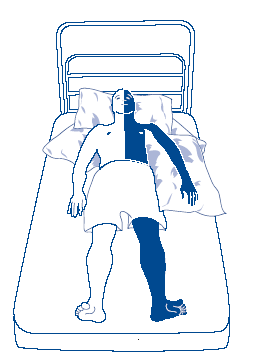
Supine lying position
• Lie with the head elevated 0–30 degrees; head and trunk aligned in a straight line
• Place a pillow under the shoulder on the weakened side; arm comfortably extended and placed alongside the body
• Wrist straight; palm down or palm up is acceptable; fingers extended
• Legs straight; place a towel under the knee to keep the knee slightly bent
• For the feet, use a small towel or a water-filled glove to support the side of the ankle so the foot stays upright and to prevent pressure sores on the ankle bone
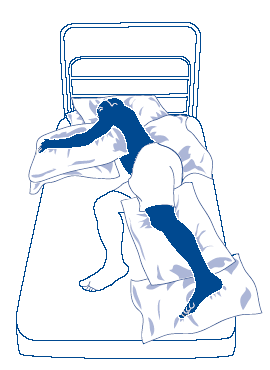
Side-lying on the good side
• Head slightly inclined forward
• For the patient’s weakened arm, place a pillow under the arm from the upper arm to the forearm, with the patient’s arm reaching forward
• Elbow extended, wrist straight, fingers extended
• For the weakened hip and knee, place a pillow from the hip to the foot; position the hip and knee flexed about 30 degrees; ankle in a neutral position
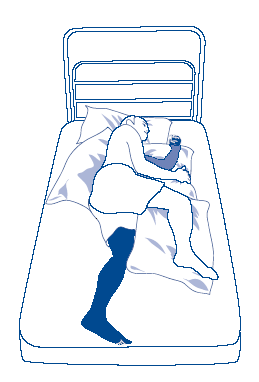
Side-lying on the weakened side
• Head slightly inclined forward
• For the good hip and knee, place a pillow from the hip to the foot
• Weakened arm reaching forward, elbow straight, palm up
• Weakened leg extended, knee slightly bent, ankle in a neutral position
Sitting at the bedside
• Sit with the head upright; both shoulders at the same level
• Trunk upright; distribute weight equally on both sides
• Hands placed on the bed; feet on the floor; distribute weight equally on both sides