
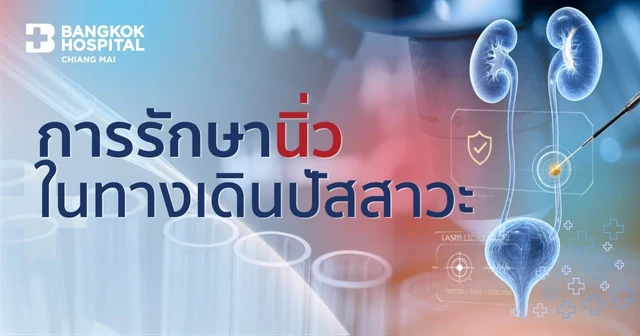

After being diagnosed with urinary tract stones, a question patients often wonder is: “Do stones require surgery?” The answer is not everyone needs surgery.
Patients with small stones may be able to pass them naturally and, if there are no complications, may be treated with symptom monitoring together with medication and care as advised by the physician.
On the other hand, if the stone is large and cannot pass on its own, causes urinary tract obstruction, results in abnormal kidney function, or is accompanied by infection, the physician may consider procedural treatments such as stone fragmentation, endoscopy, or percutaneous kidney access.
Therefore, stone treatment is not determined by stone size alone; it must be assessed together with the stone’s location and characteristics, symptoms, kidney function, overall health, and each patient’s individual risk.
What are urinary tract stones?
Urinary tract stones occur when minerals or certain substances in urine crystallize and aggregate into a stone. They can be found from the kidneys and ureters to the bladder.
Symptoms may vary depending on the location and size of the stone, such as:
- Pain in the lower back or flank, especially intermittent pain
- Pain radiating to the lower abdomen or groin
- Burning or painful urination
- Frequent urination or urgency
- Blood in the urine
- Nausea or vomiting
However, some stones may cause no symptoms and are discovered incidentally during a health check-up or medical imaging.
Do stones require surgery?
Stones do not require surgery in every case.
If the stone is small and has a chance of passing on its own, the physician may choose supportive treatment and observation first.
But if the stone is unlikely to pass, causes severe pain, obstructs the urinary tract, impairs kidney function, or causes complications, the physician may consider procedural treatment.
The most appropriate treatment must therefore be considered on an individual basis.
1. Supportive (conservative) treatment
For patients with small stones that may pass on their own, the physician may choose supportive treatment, which may include:
- Pain medications to control symptoms
- Drinking water as advised by the physician
- Symptom monitoring
- Follow-up tests to assess whether the stone has passed
In some patients, the physician may consider Medical Expulsive Therapy (MET), or medications to help increase the chance that the stone will pass through the ureter—especially in patients with lower ureteral stones and suitable characteristics.
Medication use and the amount of water to drink must be considered based on symptoms, stone location, kidney function, and the patient’s comorbidities. Patients should not buy and take medications on their own without consulting a physician.
2. Shock wave lithotripsy (ESWL)
ESWL (Extracorporeal Shock Wave Lithotripsy) treats stones by sending shock waves from outside the body to the stone to break it into smaller pieces. The body then passes the stone fragments through urine.
The advantage is that it does not require open surgery.
However, ESWL is not suitable for all stones. Its effectiveness depends on several factors, such as:
- Stone size
- Stone location
- Stone hardness or composition
- The patient’s anatomy
- Whether the shock waves can reach the stone
Therefore, the physician must evaluate imaging findings and patient factors before choosing this method.
3. Endoscopic treatment via the urinary tract (URS)
URS (Ureteroscopy) is a common method for treating stones. The physician inserts a small scope through the urethra and bladder into the ureter to reach the stone.
Once the stone is found, the physician can use a laser to break it into smaller pieces and remove fragments as appropriate.
Advantages of URS include:
- No open abdominal incision
- Direct access to ureteral stones
- In suitable patients, stones can be fragmented and fragments removed in a single procedure
- A high chance of stone clearance in many cases
After the procedure, the physician may consider placing a temporary Double-J stent as appropriate.
4. Endoscopic treatment of kidney stones (RIRS)
RIRS (Retrograde Intrarenal Surgery) treats kidney stones using a flexible scope passed through the urinary tract up to the kidney. A laser is then used to fragment the stone into smaller pieces and remove fragments as appropriate.
This method does not involve a large skin incision and is suitable for certain kidney stone locations and sizes.
However, selecting RIRS or another method depends on the size, number, location, and characteristics of the stones, as well as the patient’s health.
5. Percutaneous nephrolithotomy (PCNL and Mini-PCNL)
For large kidney stones—especially stones larger than 2 centimeters—or complex stones, the physician may consider PCNL (Percutaneous Nephrolithotomy).
With this treatment, the physician creates a small tract through the skin in the back into the kidney, then uses a scope and instruments to break and remove the stone.
Currently, there is a Mini-PCNL technique that uses a smaller tract in suitable patients, which may reduce tissue trauma and help patients recover faster compared with techniques that use a larger tract.
However, the appropriate treatment approach and instrument size depend on the characteristics of the stone and the individual patient.
What is a Double-J stent, and why is it placed?
Double-J stent (DJ stent), or a Double-J stent, is a small tube placed by the physician inside the ureter to help urine flow easily from the kidney to the bladder.
A physician may consider placing a Double-J stent in certain cases, such as after stone treatment or when there is ureteral swelling and obstruction.
While a Double-J stent is in place, some patients may experience:
- Dull aching pain in the lower back or flank
- Frequent urination
- Painful urination
- Slight blood in the urine
These symptoms can occur in people with a Double-J stent, but if there are severe abnormal symptoms—fever, chills, worsening pain, or clearly abnormal urination—contact a physician immediately.
When are urinary tract stones considered an emergency?
Some cases can be monitored and treated according to plan, but stones that cause obstruction together with infection require urgent treatment.
Warning signs that warrant prompt medical attention include:
- Fever or chills together with lower back or flank pain
- Severe lower back or flank pain
- Decreased urination or inability to urinate
- Severe fatigue or generalized abnormal symptoms
- People known to have stones who also have a urinary tract infection
In cases of urinary tract infection together with urinary tract obstruction, the urgent goal is to drain the obstructed urine and control the infection, not necessarily to remove the stone immediately in every case.
The physician may use a Double-J stent or percutaneous drainage of urine from the kidney (Percutaneous Nephrostomy; PCN) as appropriate.
After the infection is controlled and the patient’s condition improves, stone treatment is then planned as the next step.
Comparison table of urinary tract stone treatments
| Stone characteristics or condition | Treatment approaches a physician may consider |
|---|---|
| Small stones likely to pass on their own | Observation, pain medications, and MET in suitable patients |
| Ureteral stones | ESWL or URS depending on the stone’s location and characteristics |
| Small to medium kidney stones | RIRS or ESWL in suitable patients |
| Large kidney stones, especially >2 cm | PCNL or Mini-PCNL in suitable patients |
| Complex stones | Consider treatment based on the stone’s location, size, and structure |
| Obstructing stones with infection | Urgent urinary drainage with a DJ stent or PCN before stone treatment |
Note: This table provides general information and cannot replace a physician’s diagnosis or treatment decision. The choice of treatment must be individualized.
What factors do physicians use to choose a stone treatment method?
When deciding how to treat stones, physicians typically consider multiple factors together, including:
1. Stone size
Small stones are more likely to pass on their own than large stones, but size alone cannot be used to determine the treatment method.
2. Stone location
Kidney stones and ureteral stones may require different treatment methods, and the location within the kidney also affects treatment selection.
3. Urinary tract obstruction
If a stone blocks urine flow, the physician must assess the degree of obstruction and its impact on the kidneys.
4. Infection
If infection is present together with obstruction, urgent care is required.
5. Kidney function
The physician will assess kidney function and the impact caused by stones, especially in those with a single kidney or coexisting kidney disease.
6. The patient’s health and comorbidities
Underlying diseases, current medications, treatment history, and procedural risks all affect treatment selection.
After stone treatment, can stones recur?
Stones can recur.
Successful stone removal does not mean stones will never occur again in the future. People who have had stones should therefore receive guidance on preventing recurrence, such as appropriate fluid intake, dietary behavior adjustments, and evaluation of each individual’s risk factors.
In those with recurrent stones, the physician may consider additional tests to assess the stone type and contributing factors in order to plan appropriate prevention.
Summary: Not everyone with urinary tract stones needs surgery
There are multiple options for treating urinary tract stones, ranging from supportive treatment and medications, shock wave lithotripsy ESWL, endoscopic procedures URS or RIRS, to percutaneous kidney procedures PCNL or Mini-PCNL.
The key point is that no single method is suitable for every patient.
Physicians consider the size, location, and characteristics of the stone, as well as symptoms, obstruction, infection, kidney function, and overall health, to choose the safest and most appropriate treatment.
If you have severe lower back or flank pain, fever, chills, abnormal urination, or suspect urinary tract stones, you should undergo evaluation to determine the cause and plan treatment with a physician.
Successful stone treatment is not the end point, because stones can recur. Prevention and appropriate health care are therefore just as important as treatment.