
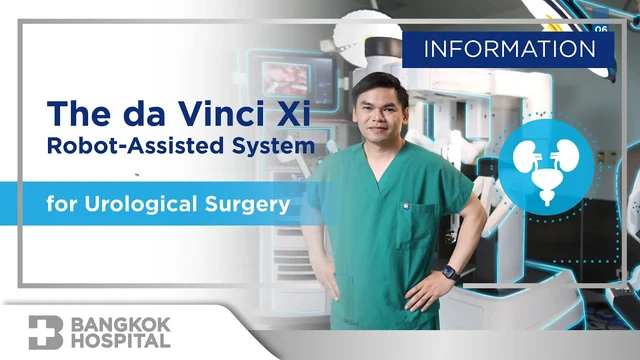
The da Vinci Xi Robot-Assisted System represents an advanced approach to urological surgery, particularly for the treatment of prostate cancer and kidney cancer. These procedures require exceptional precision to remove cancer while preserving surrounding structures that are important for postoperative function and recovery.
Video Summary
The da Vinci Xi Robot-Assisted System for Urological Surgery
The da Vinci Xi Robot-Assisted System can be used in a wide range of urological procedures involving the adrenal glands, kidneys, ureters, bladder, and prostate.
Today, robotic-assisted surgery is widely used for patients with prostate cancer and kidney cancer, where minimally invasive surgery combined with enhanced precision offers important clinical benefits.
Three Main Components of the da Vinci Xi Robot-Assisted System
Surgeon Console: The surgeon performs the entire procedure from the Surgeon Console. Every movement of the robotic instruments is controlled by the surgeon, while the robotic system translates those movements into highly precise actions inside the body.
Patient Cart: The Patient Cart supports four robotic arms that hold the surgical camera and instruments. The robotic arms provide exceptional flexibility and range of motion, allowing precise access to deep and confined anatomical spaces.
Vision Cart: The Vision Cart processes and displays high-definition 3D images in real time, giving the surgeon a detailed view of internal anatomy throughout the operation.
Enhanced Precision for Prostate Cancer Surgery
For prostate cancer treatment, the da Vinci Xi Robot-Assisted System is combined with Nerve-sparing Robotic-assisted Prostatectomy techniques to preserve important nerves and surrounding structures whenever clinically appropriate.
This approach enables surgeons to operate in difficult-to-reach areas with greater precision while minimizing the limitations of conventional minimally invasive surgery.
Preserving Important Functions After Surgery
In addition to cancer removal, one of the goals of robotic-assisted prostate surgery is to preserve postoperative function whenever possible.
This includes preserving nerves and tissues involved in:
- Urinary continence.
- Sexual function recovery.
- Overall postoperative quality of life.
By preserving these important anatomical structures, patients may experience improved functional recovery following surgery, depending on their individual condition and treatment plan.
Benefits of the da Vinci Xi Robot-Assisted System for Urological Surgery
The da Vinci Xi Robot-Assisted System offers several advantages for urological surgery:
- Enhanced precision in complex surgical procedures.
- Improved access to deep and narrow anatomical areas.
- Reduced blood loss during surgery.
- Lower risk of surgical complications.
- Smaller incisions, less postoperative pain, and faster recovery.
- Support for preserving urinary continence and sexual function in appropriate patients.
Precision Surgery for Better Recovery and Quality of Life. At Bangkok Hospital, experienced urological surgeons combine advanced surgical techniques with the da Vinci Xi Robot-Assisted System to deliver precise, minimally invasive treatment tailored to each patient. The goal is not only effective cancer treatment, but also better postoperative recovery and quality of life.