


Will my child be tall when they grow up? This is a question that parents often wonder about and worry over—especially when they notice that their child is smaller than peers of the same age. If a child continues to grow but their height remains unchanged, it is not only a warning sign that the child may not be growing appropriately for their age, but it can also affect the child’s mental well-being when compared with peers. Understanding the factors that affect a child’s height, knowing how to calculate final adult height, and regularly and correctly observing for short stature can help you better understand your child’s growth and address problems in a timely manner.
What is Short Stature?
Short stature, or Short Stature in medical terms, refers to a condition in which a child’s height is below the standard criteria compared with children of the same sex and age (height below the 3rd percentile on the growth chart) or has an abnormally slow growth rate, such as increasing in height by less than 4 centimeters per year during the prepubertal period. This condition may simply be a hereditary trait and not a disease, or it may be a warning sign of an underlying abnormality such as growth hormone deficiency, hypothyroidism, or other genetic disorders.
How to observe whether your child is small or meets the criteria for short stature
Parents can assess whether their child may have short stature (Short Stature) by observing the child’s height gain rate at each age stage. Normally, children should have a standard height gain rate as follows:
- Birth – 1 year Height gain rate: 23 – 27 centimeters per year
- 1 – 2 years Height gain rate: 10 – 12 centimeters per year
- 2 – 4 years Height gain rate: 6 – 7 centimeters per year
- Before puberty Height gain rate: 4 – 5.5 centimeters per year
During adolescence, children typically have a period of about 1 – 2 years of rapid height increase (Peak Pubertal Growth Spurt). Girls grow about 7 – 10 centimeters per year, while boys grow about 8 – 12 centimeters per year. If you find that your child’s growth rate is clearly below these thresholds, you should consult a doctor.
H2 Factors affecting children’s height
Whether a child grows and reaches the expected height criteria depends on two main factors:
- Genetics Normally, if parents are tall, children tend to be tall; if parents are short, children tend to be short.
- Environment Including appropriate nutritional status, exercise, adequate rest, and normal functioning of the endocrine system such as growth hormone, thyroid hormone, and sex hormones, etc.
Normally, children have a standard height gain rate as follows:
|
Age |
Height gain rate (centimeters per year) |
|
Birth – 1 year |
23 – 27 centimeters |
|
1 – 2 years |
10 – 12 centimeters |
|
2 – 4 years |
6 – 7 centimeters |
|
Before puberty |
4 – 5.5 centimeters |
|
During adolescence, children have about 1 – 2 years of maximum height increase (Peak Pubertal Growth Spurt) |
|
***In any case, you can roughly know your child’s final adult height in advance through evaluation and prediction methods for adult height.
Assessing and predicting final adult height
There are two main methods to assess and predict final adult height as follows:

1) Calculating final height from parents’ height (Midparental Height and Target Height)
This is height based on genetic potential. Parents can try calculating their child’s approximate height themselves using this method.
Boys = (Father’s height + Mother’s height + 13) ÷ 2
For example:
Father’s height = 175 cm, Mother’s height = 152 cm.
175 + 152 = 327 cm.
Add 13 to the result: 327 + 13 = 340
Divide the result by 2: 340 / 2 = 170
170 centimeters is the approximate future height of the son.
Girls = (Father’s height + Mother’s height – 13) ÷ 2
For example:
Father’s height = 175 cm, Mother’s height = 152 cm.
175 + 152 = 327
Subtract 13 from the result: 327 – 13 = 314
Divide the result by 2: 314/2 = 157
157 centimeters is the approximate future height of the daughter.
***However, the possible final height will be within a range of plus or minus 7 – 9 centimeters. Therefore, the final height of the son in the example would be 161 – 179 centimeters, and the daughter would be 148 – 166 centimeters, respectively.

2) Calculating final height from bone age X-ray (Bone Age) (Predicted Adult Height)
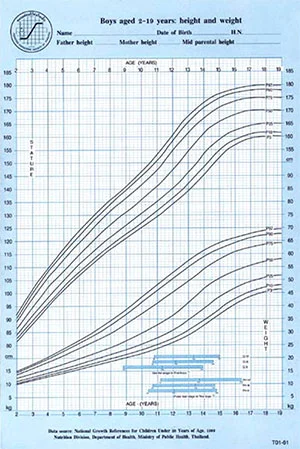
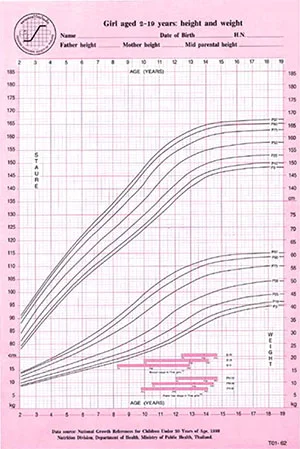
We can determine bone age from an X-ray of the left hand, from the wrist to the fingertips, by comparing the development of each bone with standard bone age X-ray images. Bone age can indicate how much growth potential remains for each child. In general, doctors monitor a child’s development and growth using standard growth charts by sex and ethnicity, including height- and weight-for-age charts. Parents can plot their child’s height and weight to compare with these normal values.
Standard growth charts for girls and boys
Height-boosting foods: nutrition that parents should not overlook
Although genetics plays an important role, appropriate nutrition is also a factor that helps maximize a child’s height potential. Foods that support the growth of bones and muscles include:
- High-quality protein: such as eggs, lean meat, fish, and tofu—important sources of amino acids for building cells and various tissues.
- Calcium: such as cow’s milk, yogurt, cheese, small fish eaten with bones, and dark green leafy vegetables (e.g., kale, broccoli), which help strengthen bones.
- Zinc: such as seafood, liver, and various grains, which helps support growth hormone function.
- Vitamin D: the body can synthesize it from mild morning sunlight, or it can be found in mushrooms and marine fish; it helps the body absorb calcium efficiently.
Common misconceptions about increasing height
In an era with abundant information, there are several beliefs about increasing height that may mislead parents, including:
Drinking milk instead of water will make you taller
Milk is beneficial for bones, but drinking too much without eating a balanced diet from all five food groups may cause excess energy intake and lead to obesity. Obesity is one factor that can trigger early puberty and cause the growth plates to close sooner.
Hanging from a bar helps lengthen bones
Hanging from a bar stretches muscles and spinal joints, making the back straighter and giving a temporary appearance of being taller. However, it does not permanently lengthen long bones (such as leg bones), which are the main determinant of height.
Height-increasing supplements definitely work
Currently, there is no medical evidence confirming that any medicine or supplement can guarantee increased height. If a child does not have nutrient deficiencies, improving nutrition through regular meals remains the best and safest approach.
A doctor can calculate your child’s future height more clearly
Normally, doctors use information from both methods: calculating genetic potential height together with bone X-rays to assess bone age. Bone age can indicate how much growth potential remains. The data are then analyzed together to estimate final height. Bone age does not have to match chronological age, because other factors and hormones also play a role—especially sex hormones. This type of calculation requires consultation with a specialist or a pediatric endocrinologist.
Precocious puberty: a hidden threat that makes children grow fast but stop growing taller early
For children who suddenly grow rapidly and noticeably surpass peers of the same age, be cautious—they may be at risk of precocious puberty, which causes rapid growth in the early stage and bone age that advances beyond chronological age. Then the growth plates close earlier than expected, resulting in a child who grew quickly at first becoming an adult who is not tall or is small in the future.
In addition to affecting height, precocious puberty also impacts a child’s mental well-being—especially in girls, who often develop breasts before age 8 or have their first period before age 9, making their bodies different from peers. In boys, it can be observed from testicular volume typically greater than 4 cc, for example. If a child has this condition, they should see a doctor for treatment to slow puberty. The doctor will assess bone age and other factors such as hormones and genetic height potential, etc., to diagnose and evaluate treatment, and provide consultation on whether injections to delay growth plate closure to increase height are appropriate. This depends on each individual case.
The Pediatric Center, Bangkok Hospital, is ready to provide consultation regarding children’s height
Regularly monitoring your child’s development and growth is something parents should not overlook. If you suspect that your child’s height is below the criteria or that they are growing too fast for their age, the Pediatric Center at Bangkok Hospital is equipped to care for and assess children’s development at every age, with a team of pediatric specialists in endocrinology and metabolism. We provide detailed diagnostic evaluation—from genetic analysis and bone age assessment to consultation for holistic health care planning—so that children can grow appropriately for their age and have strong health.
Article summary
If you suspect that your child is growing rapidly or too fast for their age, you can bring your child for examination and consultation with physicians specializing in precocious puberty at the Pediatric Center, Bangkok Hospital, where a medical team is available to diagnose and provide holistic care from birth through adolescence.
Source:
- Article “How to Maximize Adult Height” by Suthiphong Watcharasinthu, from a teaching manual on health promotion in the Bachelor of Nursing Science curriculum by the Thai Health Promotion Foundation (ThaiHealth).
Frequently Asked Questions (FAQ) about children’s height and short stature
1. Can short stature be treated to make a child taller?
Treatment for short stature depends on the cause. If it is due to growth hormone deficiency, the doctor may consider hormone replacement therapy. However, if it is due to genetics or the growth plates have already closed, hormone treatment may not be able to increase height. Therefore, diagnostic evaluation should be performed to determine the true cause.
2. Does drinking a lot of milk always help increase a child’s height?
Milk is a beneficial source of protein and calcium for building bones, but height does not depend on milk alone. Children need to receive a complete range of nutrients, along with impact-bearing exercise to stimulate bones (such as jump rope and basketball) and adequate sleep.
3. At what age should I take my child for a bone age assessment?
Parents can take their child to see a doctor for an initial evaluation as soon as they notice that the child’s height is below the standard criteria for children of the same age, or that the height gain rate is abnormally slow (e.g., growing less than 4 centimeters per year in the prepubertal period), or when signs of precocious puberty are observed.
4. Does staying up late really make a child shorter?
To some extent, yes. Growth hormone, which is an important hormone for growth, is released most during deep sleep at night. Staying up late or not getting enough rest may therefore affect the secretion of this hormone.