




Medical imaging is an essential part of modern healthcare. Medical images can help diagnose diseases, determine the stage of a disease, and monitor treatment effectively. A significant advancement in medical technology, particularly in the field of nuclear medicine, is Positron Emission Tomography/Computed Tomography (PET/CT) scans, often simply referred to as PET.
Nuclear medicine imaging uses the principle of tracking minute amounts of radioactive pharmaceuticals introduced into the body to trace pathology or abnormalities. For PET/CT scans, a specific type of radioactive pharmaceuticals are used, which are labeled with positron-emitting radionuclides. These radionuclides are usually produced by particle accelerators such as cyclotrons. Most of these radioactive drugs have a short half-life. The most commonly used radionuclides are Fluorine-18, Carbon-11, Oxygen-15, and Nitrogen-13. Although there are various types of radioactive drugs used for PET scans, the most commonly used one is FDG or F-18 fluorodeoxyglucose.
Steps in Producing Radioactive Pharmaceuticals for PET Scan
The process of producing radioactive drugs for PET scans involves three main steps:
- Production of radioactive pharmaceuticals by a cyclotron
- Labeling the radioactive material to obtain the drug or radioactive pharmaceutical
- Quality control of the radioactive pharmaceuticals
Step 1: Production of Radioactive Pharmaceuticals by a Cyclotron
The principle involves accelerating proton particles to high energy and allowing these high-energy protons to undergo nuclear reactions with a target substance to change it into the desired radionuclide, such as producing Fluorine-18 by reacting high-energy protons with Oxygen-18 present in water. This water is special, containing Oxygen-18 molecules, whereas ordinary water consists mostly of Oxygen-16 molecules, which are more common and hence cheaper.
When high-energy protons react with Oxygen-18, it converts into Fluorine-18, which emits beta particles. Fluorine-18 has a half-life of 110 minutes, meaning its quantity reduces by half every 110 minutes.
Step 2: Labeling the Radioactive Material to Obtain the Drug or Radioactive Pharmaceutical
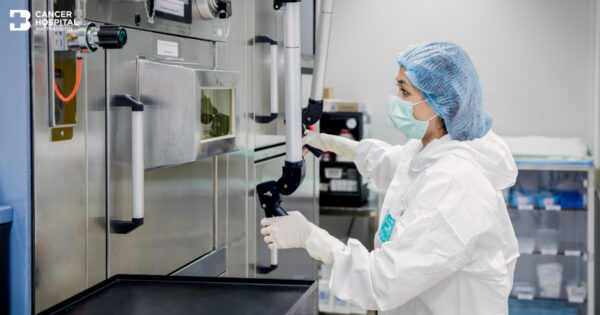
Once an adequate amount of Fluorine-18 is produced, it is transferred to a radiopharmacy laboratory to label it with the desired radioactive pharmaceutical using an automatic synthetic machine due to the high radiation level and short half-life. Producing radioactive pharmaceuticals is usually done using an Automatic Synthesis Module within a radiation shield. The production occurs in a specially designed clean and sterile radiopharmacy laboratory conducted by skilled radiochemists or radiopharmacists using aseptic techniques. The radioactive material produced by the cyclotron is then processed and synthesized through computer-controlled machinery.
The production time for each type of radioactive pharmaceutical varies, and due to their short half-lives, they need to be produced daily for patient services. Once the radioactive material reacts with prepared chemicals in the synthesis machine, the radioactive pharmaceutical produced is purified and filtered through various filters to ensure quality and sterility before being used on patients. Every batch of radioactive pharmaceuticals undergoes quality testing.
Step 3: Quality Control of Radioactive Pharmaceuticals
To ensure that the produced radioactive pharmaceuticals meet quality standards and pose no side effects to patients, quality control involves analyzing the chemical properties to check for purity, contaminants, and impurities in the radioactive drugs. Once they meet the quality standards, they can be used on patients.
Due to daily production of radioactive pharmaceuticals and the necessity for patients to be prepared correctly for their appointments to ensure accurate results, patients looking to undergo a PET/CT scan must schedule an appointment at least 1 day in advance.
Radioactive pharmaceuticals available at Bangkok Cancer Hospital Watthanosoth for PET/CT scans include:
- FDG or F-18 fluorodeoxyglucose is the most used radioactive pharmaceutical for PET/CT scans. It is used for diagnosing various types of cancer, determining the stage of the disease, monitoring treatment, and planning. It is also used for diagnosing brain disorders in patients with cognitive decline.
- FDOPA or F-18 fluorodopa is used in diagnosing patients with Parkinson’s Disease and can also be used for diagnosing patients with Neuroendocrine Tumors. FDOPA production is complex and time-consuming with high production costs, therefore it is only available on certain days.
- F-18 NaF is a radioactive pharmaceutical used for PET Bone Scans to observe the spread of cancer to the bones.
- PiB or C-11 PiB or Pittsburgh Compound B is used for diagnosing Alzheimer’s Disease. It has a very short half-life of 20 minutes, meaning every 20 minutes, its quantity reduces by half. Therefore, patients wishing to undergo a PET/CT scan with PiB need to register at the PET/CT department and prepare at least 1 hour in advance. If patients are late, the radioactive pharmaceutical may have decayed completely and the scan cannot be performed.
- C-11 Acetate helps in diagnosing prostate cancer. Like C-11 PiB, C-11 acetate has a short half-life of only 20 minutes. Patients needing a PET scan with C-11 Acetate must register and prepare in advance at the PET/CT department.
As modern medicine constantly advances, Bangkok Cancer Hospital Watthanosoth is committed to developing medical services to meet international standards and modernity, providing comprehensive care for cancer patients.
Information: Dr. Ananya Ruangma (HOD) Oncology Imaging & Nuclear Medicine